
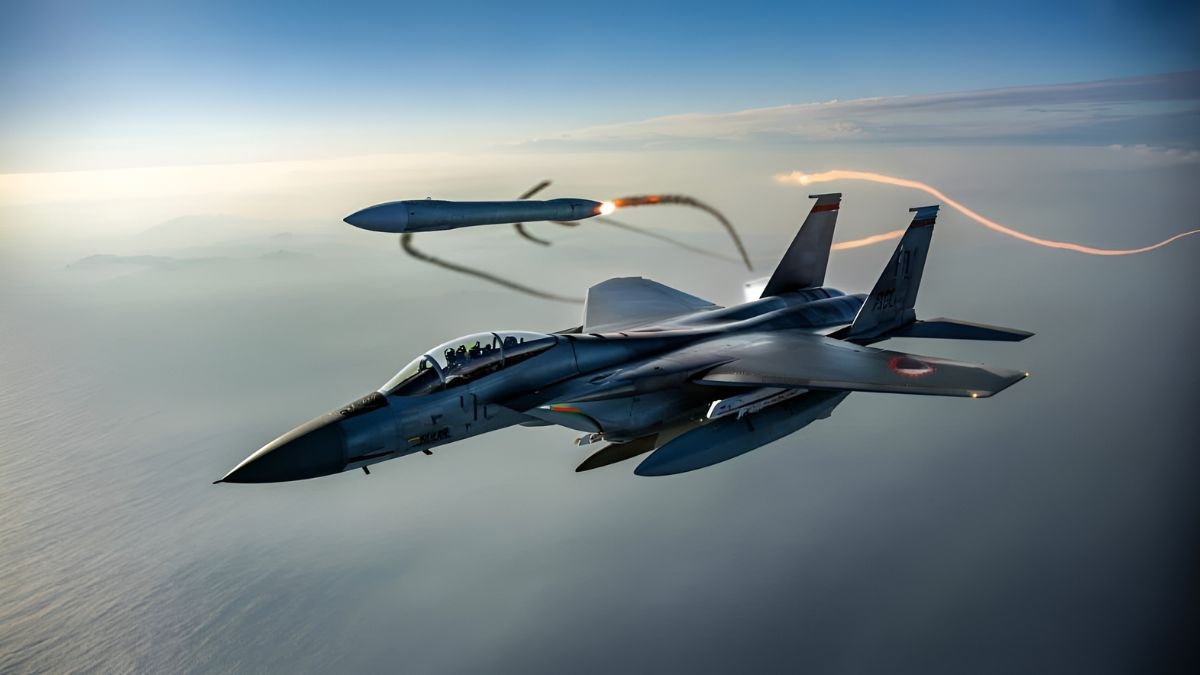
It’s a hazy morning over the Pacific Ocean. A Japanese F-15 fighter jet glides silently through the clouds. No sounds of war, no alarms. But a long, dark shape hanging beneath its wing tells a different story. There are no bright markings on it, no visible signs from a distance. It’s something the enemy won’t see until it’s too late. The pilot’s voice is calm on the radio; the missile drops, disappears into the air, and then suddenly darts forward. For a moment, the sky seems empty. The next moment, the telemetry screens on the ground come alive.
Somewhere far away, a “red line” has been crossed, one that until now was considered only theoretical.
The Non-Linear Missile: Japan’s New Strategy
This new Japanese stealth missile is unlike the straight-flying missiles of the old Cold War era. Instead of flying in a straight line, it twists, turns, and performs corkscrew maneuvers in mid-air. Its purpose is clear—to confuse modern and extremely expensive air defense systems. On paper, it’s a long-range “standoff missile,” with a reported range of over 1,000 kilometers. But in reality, it’s not just a weapon but a strategic message.
This missile flies at low altitude to evade radar, is less visible due to its stealth design, and finally changes direction abruptly to reach its target. The operator sitting at the radar screen first sees a faint signal, then nothing, and then only the news of an explosion. From this moment on, the sky becomes not a boundary line, but a pathway.
The Transformation of the Type-12 Missile: From Defense to Offensive Capability
The prime example of this transformation is Japan’s Type-12 surface-to-ship missile. It was once a limited weapon used solely for coastal defense, with a range of less than 200 kilometers. But in recent years, Japan has quietly made significant modifications. The missile’s airframe has been made more stealthy, the seeker system has been upgraded, and its range has been increased dramatically.
The result is that the same missile can now target enemy bases, ships, and infrastructure more than 1,000 kilometers away. The weapon that once defended the coastline now has the capability to reach deep into enemy territory.
F-35s, Drones, and Missiles: A Layered Attack System
This new missile cannot be viewed in isolation. Japan is integrating it with its advanced F-35 fighter jets and “loyal wingman” drones. The strategy is for the aircraft and drones to remain in a safe zone far from enemy territory, launch these stealth missiles from there, and then have the missiles autonomously fly at low altitude, maneuvering to reach their targets.
This means that the pilot or ship doesn’t need to be directly exposed to danger. The missile takes the risk, not the human.
Growing Unease in Asia: Beijing and Pyongyang Are Watching
Every test flight, every budget announcement, and every press release from Japan is being closely watched by China and North Korea. For decades, Japan imposed a kind of self-restraint—no offensive attacks, no first-strike capability. Even the language used was carefully chosen.
Now, Tokyo openly talks about “counterstrike capability.” This means that if a threat is perceived, a preemptive or retaliatory strike can be launched against enemy bases. Legal limitations still exist, but they appear to be stretching. And when a country with Japan’s technological and industrial power moves in this direction, the security calculus of the entire region changes.
From Shield to Spear: Japan’s Mental and Strategic Shift
Many officers in Japan’s Self-Defense Forces acknowledge in private conversations that this shift is not just technological but also a change in mindset. Previously, their job was to hold the line and wait for assistance. Now they are practicing scenarios where Japanese missiles would strike enemy launch sites or ships preemptively.
Launchers will be concealed on trucks, dispersed across remote islands, and linked to satellites and AWACS aircraft, and the missiles will be given trajectories that are anything but straight—low-altitude flight, skimming along the ground, sudden turns, and corkscrew maneuvers.
Technology That Disrupts Defense
The real impact of this missile technology is on air defense systems. Such systems require clear calculations—the missile is here, it will go there, fire now. But when a missile twists and turns in midair, changes direction, and suddenly dives, the interceptor’s calculations are thrown off.
Combined with stealth materials, radar-absorbing designs, and infrared seekers, this further reduces the reaction time for defenses. This reduction of a few seconds can change the entire game.
Politics, Generations, and a Growing Divide
The debate within Japan is intense. The older generation still remembers the post-war promise—“never again, never a first strike.” The younger generation sees a different world—hypersonic missiles, drone swarms, and ballistic missile tests landing nearby. The emotional distance between these two perspectives is growing every year.
Analysts say that if Japan doesn’t take this step, it could become an easy target. Peace activists warn that the more long-range weapons there are, the greater the temptation to use them.
Distance Is No Longer a Guarantee of Security
People standing on a train platform in Tokyo may not realize it, but in the strategic world, the meaning of distance has changed. The bases once considered safe are now under the stealthy shadow of a 1,000-kilometer range. The map remains the same, but its meaning has changed.
This missile isn’t just altering its trajectory in the sky; it’s also altering Japan’s identity and the old assumptions of its defense policy.
Conclusion: Security or Instability?
Will this change make the region safer or more volatile? The answer won’t be found on any radar screen. It lies somewhere between fear and balance, deterrence and provocation, and the desire for security at home and the risk of a first strike.
Japan’s new stealth missile is made of metal and software, but its real impact is psychological and political. And perhaps that’s why it’s being seen not merely as a weapon, but as a “red line.”
FAQs
Q. What makes Japan’s new missile different from older weapons?
A. It uses stealth design and mid-air corkscrew maneuvers to evade radar and air-defense systems.
Q. How far can the new Japanese missile strike?
A. The missile is reported to have a range of more than 1,000 kilometers.
Q. Why is this missile seen as crossing a “red line”?
A. Because it gives Japan a clear counterstrike capability, shifting from purely defensive weapons to long-range offensive reach.
Q. Which countries are most concerned about this development?
A. China and North Korea are closely monitoring Japan’s missile tests and military upgrades.
Q. How could this missile change regional security?
A. It may trigger an arms race, force changes in air-defense strategies, and alter the balance of power in East Asia.