
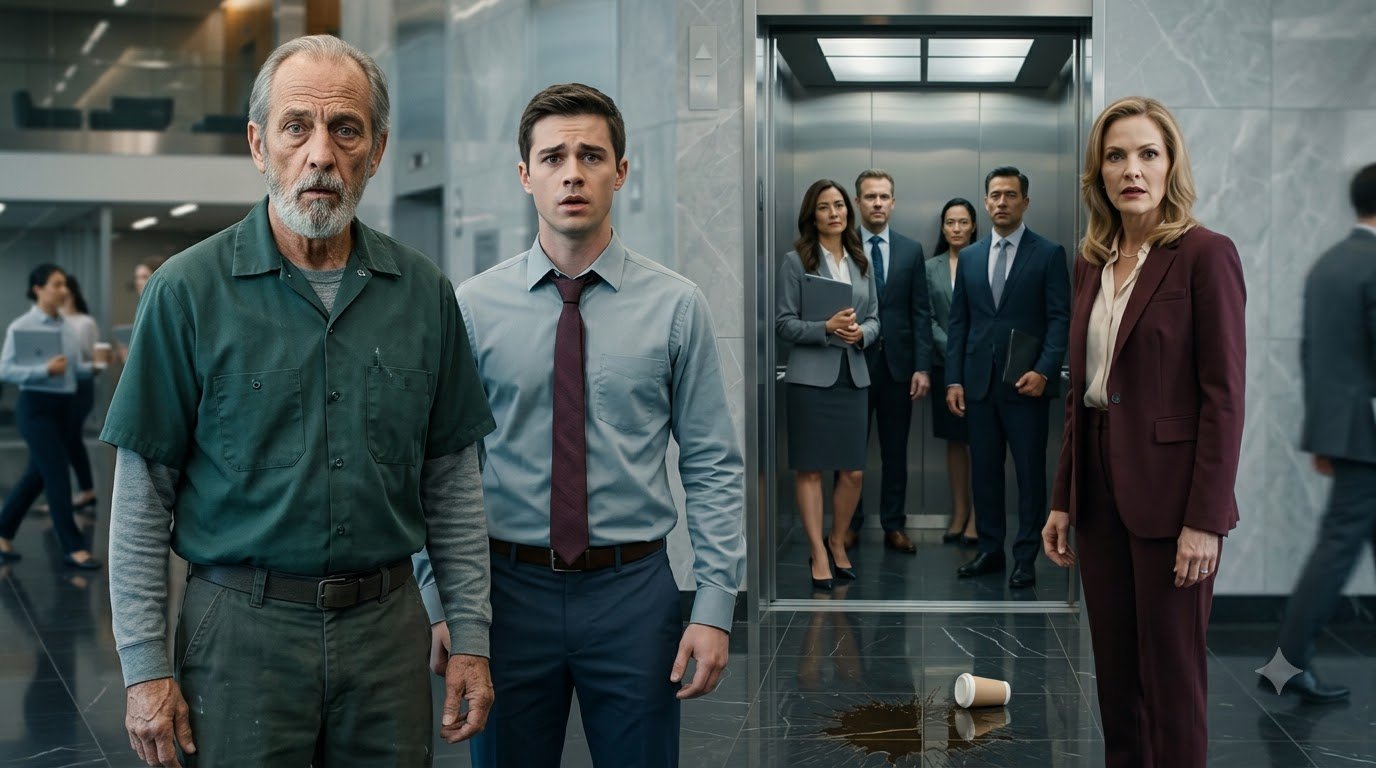
Part 1 — The Janitor Everyone Ignored
By 8:30 in the morning, the main lobby of Northstar Dynamics already felt like a city of its own.
Employees crossed the polished black marble carrying laptops, coffee cups, presentation folders, and the quiet anxiety of people trying not to be late. Glass elevators moved constantly behind the reception desk. Beyond the floor-to-ceiling windows, downtown Seattle sat beneath a flat gray sky.
Northstar Dynamics was one of the country’s largest technology companies. Its products powered logistics networks, hospitals, financial systems, and manufacturing plants across the United States.
Its executives appeared on business television.
Its quarterly results moved markets.
And its headquarters occupied twenty-seven floors of glass, steel, stone, and carefully designed confidence.
Moving through all of it was a seventy-two-year-old man pushing a cleaning cart.
His name was Samuel Brooks.
Almost nobody knew it.
Samuel wore a faded forest-green janitor’s shirt, dusty charcoal-brown work trousers, and old dark-burgundy boots polished by years of use rather than care.
His silver-gray hair was thinning.
His beard was uneven.
Deep lines covered his face.
Most employees passed him without speaking.
Some stepped around his cart without looking at him.
A few nodded.
Very few knew his name.
Samuel didn’t seem offended.
He simply worked.
He cleaned fingerprints from glass.
He emptied wastebaskets.
He wiped coffee rings from tables.
He mopped footprints from the marble.
And he watched.
Samuel believed people revealed themselves when they thought nobody important was paying attention.
He noticed the executive who always thanked delivery drivers.
The analyst who never held the elevator for contractors.
The manager who smiled warmly at vice presidents but never at receptionists.
The intern who stopped to pick up someone else’s papers.
Small things.
Samuel believed small things were often the most honest.
The Young Intern
At 8:37, Ryan Carter entered the building.
Ryan was twenty-two and only six weeks into a summer internship in strategy and operations.
His pale dusty-blue shirt was neatly pressed. His burgundy tie was slightly crooked, and his navy trousers were carefully ironed. His off-white sneakers made him look younger than most people around him.
He knew that.
He also knew he didn’t belong to the same world as many of the executives crossing the lobby.
His father taught high school history in Ohio.
His mother worked in hospital administration.
There was no family connection waiting for him inside Northstar.
No uncle on the board.
No family friend in senior management.
Ryan had earned the internship through interviews, recommendations, good grades, and a little luck.
He was determined not to waste it.
As he crossed the lobby, he noticed Samuel mopping near the east elevators.
Ryan slowed.
“Morning.”
Samuel looked up.
“Morning.”
Ryan continued walking.
Then he stopped.
“Sir?”
Samuel waited.
Ryan pointed toward a planter near the windows.
“There’s water leaking underneath that one again.”
Samuel followed his gaze.
“I appreciate it.”
“Sure.”
Ryan walked away.
Samuel watched him for another second before returning to work.
It wasn’t the first time Ryan had spoken to him.
And that mattered.
The Coffee
At 9:18, Samuel finished cleaning a wide section in front of the digital reception desk.
The marble reflected the ceiling lights in long white bands.
Samuel placed his mop into the bucket.
The elevator chimed.
Olivia Hayes stepped out.
At thirty-four, Olivia was already a senior vice president overseeing one of Northstar’s fastest-growing divisions.
She was admired by some employees and feared by many others.
Tall and sharply dressed, Olivia moved as though the building itself should rearrange around her schedule.
Her deep wine-red blazer was immaculate.
Her cream blouse didn’t have a wrinkle.
Her honey-blonde hair fell perfectly over one shoulder.
Two younger executives followed her while discussing a quarterly forecast.
Olivia carried a paper coffee cup.
Almost empty.
She crossed the section Samuel had just cleaned.
Then she stopped.
Samuel shifted his cart slightly to give her more room.
Olivia looked at the floor.
Then at her cup.
Then she tilted her wrist.
The last of the coffee spilled across the freshly cleaned marble.
A brown splash spread across the black surface.
Samuel looked down.
Then up at Olivia.
She met his eyes.
“Clean it again.”
Samuel said nothing.
Olivia added:
“That’s what you’re paid for.”
She didn’t shout.
Somehow, that made the words worse.
Several nearby employees heard.
Nobody intervened.
Then Ryan entered the lobby.
He saw everything.
His first instinct was to keep walking.
He knew exactly who Olivia Hayes was.
Her recommendation could accelerate a career.
Her criticism could bury one before it began.
Ryan had been at Northstar for barely six weeks.
He had student debt.
He needed this opportunity.
There was no rational reason to involve himself.
Samuel reached for his mop.
Ryan heard himself speak.
“He didn’t do anything wrong.”
The lobby went quiet.
Olivia turned.
“Excuse me?”
Ryan’s heart began beating faster.
“He just cleaned that floor.”
Olivia stared at him.
“Who are you?”
“Ryan Carter.”
He swallowed.
“Summer intern.”
A faint smile appeared on Olivia’s face.
“Of course.”
Then she told him to learn when something was none of his business.
Ryan should have stopped.
Instead, he said:
“His responsibility isn’t to be humiliated.”
The lobby became completely silent.
Olivia stepped closer.
“You’re unusually confident for an intern.”
“I’m not trying to be.”
“You are.”
Then came the threat.
“Defend him again… and don’t bother coming back tomorrow.”
Ryan felt his future disappearing.
But he didn’t apologize.
“Understood.”
Olivia turned away.
Samuel looked at Ryan.
Something changed in his steel-blue eyes.
He reached into his worn shirt and pulled out an old black smartphone.
He dialed.
Someone answered almost immediately.
Samuel spoke calmly.
“Yes.”
A pause.
“I’ve found exactly who I was looking for.”
Ryan stared.
Olivia stopped walking.
Samuel continued:
“Please ask the board to come down to the main lobby.”
The call ended.
Nobody moved.
Olivia turned toward him.
“What did you just say?”
Samuel slipped the phone into his pocket.
“You heard me.”
“The board?”
“Yes.”
Olivia gave a nervous laugh.
“Why would the board come down here for you?”
Samuel looked at the coffee stain.
Then at her.
“That’s a reasonable question.”
The elevator chimed.
Everyone turned.
And Olivia Hayes suddenly realized that the janitor she had just humiliated might be the one person in the building she should never have underestimated.
To be continued in Part 2…
Part 2 — The Secret Behind the Janitor
The elevator doors opened.
Three senior executives stepped out.
Then a fourth.
Then Diane Mercer, chair of Northstar Dynamics’ board of directors.
Ryan recognized her immediately.
He had seen her photograph in annual reports and company presentations.
Diane was in her early sixties, silver-haired and composed. She was known for speaking less than everyone else in a room while somehow controlling the room anyway.
She crossed the lobby.
What shocked Ryan wasn’t that she had come.
It was how she greeted Samuel.
“Samuel.”
No surprise.
No confusion.
Just familiarity.
Samuel nodded.
“Diane.”
Olivia’s face lost color.
Diane looked at the coffee stain.
Then at Olivia.
Then at Ryan.
“Is this the intern?”
Samuel answered.
“Yes.”
Olivia finally found her voice.
“Diane, I think there’s been some misunderstanding.”
Samuel looked at her.
“There hasn’t.”
Olivia tried to dismiss what had happened as a personnel issue.
Diane asked:
“In the middle of the lobby?”
Olivia had no answer.
Samuel moved his cart away from the wet area.
One of the board members asked if they should go upstairs.
Samuel shook his head.
“Not yet.”
“The first part happened here,” he said. “The first answer should happen here too.”
Ryan felt uncomfortable.
“Samuel, you don’t have to—”
Samuel raised a hand.
“I’m not doing this to embarrass anyone.”
His eyes moved toward Olivia.
“Including her.”
Then Samuel turned toward Ryan.
“Why did you speak up?”
Ryan hadn’t expected the question.
“It was wrong.”
“You knew who Ms. Hayes was?”
“Yes.”
“You knew she could hurt your internship?”
Ryan hesitated.
“Yes.”
“And you still spoke.”
Ryan shrugged.
“I guess.”
Samuel asked whether he had calculated the consequences first.
Ryan gave a nervous laugh.
“If I had, I probably would’ve stayed quiet.”
A few people smiled.
Samuel did too.
“That’s important.”
Olivia crossed her arms.
“Important for what?”
Samuel turned toward her.
“For the reason I’ve been here.”
Ryan frowned.
“Here?”
Samuel looked at him.
“Six weeks.”
Ryan finally understood.
“You mean working here?”
“Yes.”
Ryan glanced at the cleaning cart.
“As a janitor?”
“As a janitor.”
Olivia stared.
“You staged this?”
“No.”
“You wanted someone to treat you badly?”
“Absolutely not.”
Samuel explained that he had hoped to finish six weeks without witnessing something like this.
Diane then revealed the truth.
Samuel had asked the board for permission to conduct an unusual observation program.
Ryan stared.
“You were evaluating employees?”
“Not exactly,” Samuel replied.
“I was looking for someone.”
Ryan remembered the phone call.
“Exactly who I was looking for.”
Samuel nodded.
Olivia frowned.
“Looking for Ryan?”
“Not Ryan specifically.”
Diane stepped forward.
“Northstar has a leadership fellowship funded privately through a trust.”
Ryan knew about the program.
The Daniel Brooks Leadership Fellowship.
It selected only a handful of people each year.
Participants received executive mentorship, rotated through major divisions, and often moved into leadership positions.
But interns were almost never selected.
Ryan looked at Samuel.
Then something clicked.
“Brooks?”
Samuel’s expression changed slightly.
Diane answered:
“Daniel Brooks was Samuel’s son.”
The lobby fell silent.
Samuel looked down at the mop handle.
“Daniel worked here twenty-four years ago.”
Ryan quietly said:
“I’m sorry.”
Samuel nodded.
“Thank you.”
Daniel had been brilliant.
Ambitious.
Fast.
But he had once believed that the smartest person in the room should usually be the person making the decisions.
Near the end of his life, Daniel realized how dangerous that attitude could become.
He began noticing the people everyone else ignored.
Assistants.
Security guards.
Janitors.
Interns.
People who worked hard without appearing in quarterly presentations.
Before Daniel died, he wrote his father a letter.
He said the biggest danger in a company wasn’t failure.
It was status.
Status taught people to notice who could help them and ignore everyone else.
Daniel eventually told his father:
“If I ever get another chance to choose leaders, I want the person who behaves well before anyone powerful is watching.”
After Daniel died, Samuel created the fellowship in his name.
Ryan finally understood why Samuel had been watching.
He wasn’t searching for the most impressive employee.
He was searching for someone whose character appeared when there was nothing to gain.
And that morning, Ryan had finally given him his answer.
But Samuel wasn’t finished.
Because the board had another question to answer.
What would happen to Olivia Hayes?
To be continued in Part 3…
Part 3 — Daniel’s Letter and the Leadership Test
The twenty-third floor felt completely different from the lobby.
Quiet carpet.
Glass walls.
Smaller groups.
Fewer people.
The city stretched beyond the windows beneath a pale gray sky.
Ryan had never been invited to the executive board level.
Now he sat beside Diane Mercer.
Across from him was Samuel Brooks.
The man everyone had believed was simply a janitor.
Ryan finally asked:
“What exactly is your relationship with Northstar?”
Samuel smiled.
“There it is.”
He explained that he had invested in the company when it had only nineteen employees.
Ryan stared.
“Nineteen?”
“Nineteen.”
“Were you a founder?”
“No.”
Samuel explained that he had never written the software, built the hardware, or run the company.
But his trust had become a significant long-term shareholder.
“Significant enough that the board usually answers my calls.”
Ryan laughed.
“Apparently.”
Then Diane explained something important.
Ryan’s internship was secure.
Olivia could not simply fire him from the lobby.
But there were other complaints.
Several employees had reported public belittling, threats toward junior employees, and different treatment depending on someone’s title.
The board had discovered a pattern.
Olivia was being placed on immediate administrative leave from management duties while a formal investigation began.
Ryan thought about what Samuel had told him.
One terrible moment shouldn’t necessarily define someone’s entire career.
But if the behavior was a pattern, that changed everything.
Then Samuel told Ryan about Daniel.
When Daniel was twenty-six, he once yelled at a maintenance worker in front of twenty people after believing the man had damaged an equipment case.
Later, security footage proved someone else had caused the damage.
Daniel apologized.
But he apologized privately.
The humiliation had been public.
That experience changed him.
He began to understand that he had protected his own pride more carefully than he had repaired another person’s dignity.
Months before his death, Daniel wrote the letter.
Diane opened a folder.
Inside was a photocopy.
Samuel slid it toward Ryan.
“Read the first page.”
Ryan picked it up.
Samuel asked him to read it aloud.
Ryan began:
“Dad, I used to think leadership meant being the person nobody questioned.”
He continued:
“Now I think leadership means becoming the person who can survive being questioned without needing to destroy whoever asked.”
Ryan paused.
The room was silent.
He continued.
“I was wrong about people.”
“I learned to notice titles before faces.”
Then he reached the final line.
“If you ever get the chance to help choose who leads after people like me are gone, choose the person who still sees everyone before anyone tells them who matters.”
Ryan lowered the letter.
Samuel looked toward the window.
“That line created the fellowship.”
Ryan asked why the company didn’t simply make it part of leadership training.
Samuel smiled sadly.
“Because reading good sentences doesn’t automatically create good people.”
That’s why he watched behavior.
Not speeches.
Not surveys.
Not polished presentations.
Behavior.
Especially when nobody powerful was watching.
Then Diane opened another folder.
“We’d like to offer you the Daniel Brooks Leadership Fellowship after you graduate.”
Ryan stared.
“After I graduate?”
“Yes.”
“I’m not even done with my internship.”
Samuel smiled.
“We noticed.”
The program included eighteen months of rotations through operations, strategy, product, and customer systems.
Mentorship.
A salary.
And full tuition support for Ryan’s final year.
Ryan looked down.
He thought about his parents and everything they had sacrificed.
“I can’t accept this just because I spoke up once.”
Samuel smiled.
“Good.”
Ryan looked up.
“If you thought one moment made you worthy of everything, I’d withdraw the offer.”
Ryan laughed.
Samuel became serious.
“This isn’t a reward for defending me.”
“It’s an invitation to prove whether that moment reflects who you actually are.”
Ryan asked what would happen if it didn’t.
“Then the program ends.”
Ryan nodded.
Then he asked:
“Why me instead of someone with better grades?”
Diane replied:
“Your grades are fine.”
Samuel added:
“Not extraordinary.”
Ryan laughed.
“Thank you.”
“You’ll hear worse from me.”
Then Samuel leaned forward.
“Ryan, this company can teach you financial modeling. It can teach you operations. It can teach you how to present to a board.”
He paused.
“But if you become successful enough, people will eventually stop telling you when you’re wrong.”
Ryan listened.
“That’s when character matters most.”
Samuel pointed toward the lobby below.
“Today you were willing to risk your future for someone you thought had no power.”
“One day, you may be the person with power.”
Ryan asked:
“And what if I become like Olivia?”
Samuel smiled.
“I hope someone exactly like you is standing nearby.”
Ryan laughed.
Samuel added:
“And I hope you’re smart enough to listen.”
But before Ryan could say anything else, Diane received an update from the investigation.
Olivia’s behavior wasn’t an isolated incident.
The board would have to decide whether she deserved a second chance.
And that decision would change the lives of everyone involved.
To be continued in Part 4…
Part 4 — Olivia’s Second Chance
Two weeks later, Olivia Hayes returned to Northstar.
Not as senior vice president.
The investigation had confirmed a pattern.
She had repeatedly humiliated junior employees.
She had created fear within her division.
And she had used her position to intimidate people who believed they couldn’t challenge her.
But she had also produced strong business results.
The board gave her a choice.
She could leave the company with a negotiated departure.
Or she could return under a structured corrective plan without direct people-management authority while completing executive coaching and rebuilding trust.
To everyone’s surprise, Olivia chose to stay.
On her first morning back, Ryan saw her in the lobby.
She approached him.
“Ryan.”
He stopped.
“Ms. Hayes.”
For once, Olivia seemed uncertain.
“I owe you an apology.”
Ryan waited.
“I threatened your career because you challenged me.”
She swallowed.
“And because I thought you were too junior to matter.”
Ryan nodded.
Olivia looked toward Samuel.
He was cleaning near reception.
“I owe him a larger apology.”
Ryan replied:
“Then you should tell him.”
Olivia crossed the lobby.
Samuel looked up.
They spoke for several minutes.
Ryan stayed far enough away not to hear.
At the end of the conversation, Samuel pointed toward a faint coffee mark on a side table.
Olivia stared at him.
Then she unexpectedly laughed.
She took a cloth from Samuel’s cart.
And cleaned it herself.
Samuel smiled.
It wasn’t forgiveness.
Not yet.
It was a beginning.
Ryan Returns to College
At the end of summer, Ryan returned to college.
His future had changed because of a moment he had almost avoided.
When he told his parents about the fellowship, his mother cried.
His father remained silent for several seconds.
Then he asked:
“So you defended a janitor and got your tuition paid?”
Ryan laughed.
“That’s not exactly what happened.”
“Sounds close.”
Ryan became serious.
“I didn’t know who he was.”
His father smiled.
“Good.”
“Good?”
“Means you did it for the right reason.”
A year later, Ryan returned to Northstar.
His first day as a Daniel Brooks Fellow.
Samuel was waiting in the lobby.
Still wearing the faded forest-green janitor’s shirt.
Ryan stopped.
“You’re still doing this?”
Samuel looked at his cart.
“Doing what?”
“Cleaning.”
“The building keeps getting dirty.”
Ryan laughed.
“Everybody knows who you are now.”
Samuel shook his head.
“Not everybody.”
“Enough people.”
Samuel looked around.
“Then I’ll know who behaves well only when they’re being careful.”
Ryan smiled.
Samuel looked at Ryan’s suit.
“New?”
“Graduation gift.”
“Expensive?”
“Not really.”
“Good start.”
Ryan began the eighteen-month fellowship.
And it wasn’t easy.
He failed publicly.
Twice.
Once, he approved an analysis containing a serious forecasting error.
Another time, he promised a client a timeline that forced a technical team to work through an entire weekend.
On Monday morning, Samuel waited beside the elevators.
“Heard about your weekend.”
Ryan sighed.
“Their weekend.”
Samuel nodded.
“Better answer.”
Ryan leaned against the wall.
“I apologized.”
“To who?”
“The team.”
“Privately?”
Ryan froze.
Samuel raised an eyebrow.
Ryan understood.
“I’ll fix it.”
Samuel smiled.
“Daniel took longer to learn that.”
Ryan apologized in the full Monday meeting.
No excuses.
No explanations.
Just responsibility.
It embarrassed him.
But afterward, three engineers thanked him.
Not because the mistake disappeared.
Because he hadn’t hidden behind his title.
A Lesson That Followed Him
The fellowship taught Ryan something important.
Being a good person once wasn’t enough.
Character had to become a habit.
Every promotion created a new temptation.
Every title created distance.
Every success made it easier for people to tell you what they thought you wanted to hear.
Samuel kept reminding him of that.
“Power doesn’t change everyone,” he once told Ryan.
“It reveals what people stop having to hide.”
Ryan never forgot it.
Years later, those words would become even more important.
Because Ryan’s own career was beginning to accelerate.
And soon, he would have people beneath him who depended on his decisions.
To be continued in Part 5…
Part 5 — The Man Who Remembered Everyone’s Name
Years passed.
Ryan became a team lead.
Then director.
Then vice president of a small division.
Olivia eventually rebuilt part of her career too.
She never regained exactly the authority she once had.
But she became known for something nobody would have predicted after that morning.
She began mentoring managers who struggled with abrasive leadership habits.
One afternoon, Ryan asked her why.
Olivia answered:
“Because I know what it feels like to realize everyone around you is afraid to tell you the truth.”
Ryan thought about Samuel.
“Did he ever forgive you?”
Olivia smiled.
“He never told me.”
“That sounds like him.”
“He did invite me to lunch once.”
Ryan laughed.
“That might be the closest thing.”
Samuel Grows Older
Samuel grew older.
At seventy-seven, his back no longer allowed him to clean every day.
Northstar offered him an office.
He refused.
They offered him a formal board title.
He refused that too.
Instead, he came to headquarters two or three mornings each week.
Sometimes he pushed the old cart.
Sometimes he simply sat near reception and watched people arrive.
Ryan found him there one morning.
Samuel was looking toward the entrance.
“Still watching?”
Ryan asked.
“Always.”
A young intern entered carrying two coffees.
One slipped from her hand.
It hit the marble.
Coffee spread across the floor.
The intern froze.
A manager walking behind her sighed dramatically.
“You’ve got to be kidding me.”
Ryan looked at Samuel.
Samuel looked back.
Neither spoke.
Ryan walked toward the intern.
He grabbed several towels from the reception desk and crouched beside her.
“It’s okay.”
The intern looked mortified.
“I’m so sorry.”
“It’s coffee.”
Ryan smiled.
“Northstar will survive.”
The manager stopped.
Then slowly crouched too.
“Here.”
He helped clean the floor.
Samuel watched from his chair.
A small smile appeared.
Later, Ryan returned to him.
“Was that another test?”
Samuel replied:
“Everything is a test if you’re paying attention.”
Ryan rolled his eyes.
“You’ve been waiting years to say that.”
“Absolutely.”
They laughed.
Then Samuel became serious.
He reached into his jacket and handed Ryan a small envelope.
Ryan opened it.
Inside was the original letter from Daniel.
Ryan looked up.
“Samuel, I can’t take this.”
“You’re not keeping it.”
“Then why—”
“Turn it over.”
Ryan flipped the letter.
On the back, in Samuel’s shaky handwriting, were two words:
Found him.
Ryan stared.
“Samuel…”
The old man looked toward the lobby.
“I spent a long time wondering whether Daniel’s idea was naïve.”
“Which idea?”
“That you could find leadership before ambition changed it.”
Samuel looked at Ryan.
“I don’t think it’s naïve anymore.”
Ryan felt uncomfortable.
“I’m not that special.”
Samuel smiled.
“Good.”
“Why is that good?”
“The dangerous ones usually think they are.”
Ryan laughed quietly.
Samuel took the letter back.
“I’m placing it in the fellowship archive.”
Ryan nodded.
Then Samuel said:
“But I wanted you to understand something.”
“What?”
“The day you spoke up for me, you didn’t protect my dignity.”
Ryan frowned.
Samuel continued:
“I already knew who I was.”
He pointed gently toward Ryan.
“You protected yours.”
Ryan said nothing.
Samuel’s voice softened.
“Never trade that for a title.”
Ryan looked down.
“I’ll try.”
Samuel smiled.
“Everyone says that.”
“Then what should I say?”
“Nothing.”
Samuel leaned back.
“Just remember.”
Samuel’s Final Days
Three months later, Samuel Brooks died peacefully at home in his sleep.
Northstar’s leadership proposed naming a building after him.
Ryan opposed it.
Diane Mercer, now retired from the board, agreed.
“Samuel would hate it,” she said.
Instead, the Daniel Brooks Fellowship was renamed the Brooks Fellowship for Leadership and Character.
No statue was installed.
No giant portrait went into the lobby.
No inspirational quote was placed across the marble wall.
Samuel had hated corporate slogans.
Instead, a new tradition began.
Every fellow spent the first week rotating through jobs most people rarely noticed.
Cleaning.
Security.
Cafeteria service.
Facilities.
Reception.
Mailroom.
Not as a performance.
Not for photographs.
No executive announcements.
They learned names.
They learned schedules.
They learned what the building looked like at five in the morning and eleven at night.
They learned how many people worked hard without ever appearing in a quarterly presentation.
And that became Samuel’s greatest legacy.
But Ryan still had one final lesson to learn.
It came years later, when he had become one of Northstar’s most powerful executives.
To be continued in Part 6…
Part 6 — The Lesson Samuel Left Behind
Years later, Ryan became one of Northstar’s senior executives.
His office was large.
His calendar was full.
His decisions affected thousands of employees.
And people began treating him differently.
They laughed more quickly at his jokes.
They stopped interrupting him.
They apologized for things that weren’t their fault.
Ryan noticed.
It frightened him.
He understood what Samuel had warned him about.
Power could create distance.
Success could make people afraid to tell you the truth.
And titles could slowly change the way people saw you—and the way you saw everyone else.
One morning, Ryan walked through the lobby with three younger executives.
A janitor named Joe was cleaning near the elevators.
The others continued talking.
Ryan stopped.
“Morning, Joe.”
Joe looked up.
“Morning, Ryan.”
“How’s your wife?”
Joe smiled.
“Better. Surgery went well.”
“Glad to hear it.”
Ryan stepped into the elevator.
One of the younger executives followed.
“You know the cleaning staff personally?”
Ryan pressed the button for the twenty-third floor.
“Some of them.”
“Why?”
Ryan looked through the glass doors toward the marble floor.
For a moment, he could see another morning.
Coffee spreading across polished stone.
A faded green janitor’s shirt.
A frightened twenty-two-year-old intern.
A black phone.
Silence.
Then Ryan answered:
“Because I once watched a very successful person make the mistake of believing some people were too small to notice.”
The executive became quiet.
The elevator doors began to close.
Then Ryan saw Joe pushing his cart toward them.
Ryan reached out and stopped the doors.
“You coming up?”
Joe smiled.
“Thanks.”
“Of course.”
Joe rolled the cart inside.
No one spoke for a moment.
Ryan looked at his reflection in the glass.
His suit.
His title.
His age.
Everything had changed.
But the lesson had not.
Samuel Brooks had spent the final years of his life searching for someone who could remain decent before power arrived.
Ryan eventually understood that finding such a person was only the beginning.
The harder task was staying that person after power came.
Samuel’s Greatest Lesson
Samuel’s greatest legacy wasn’t a building.
It wasn’t a statue.
It wasn’t a board position.
It wasn’t even the fellowship.
It was a simple way of seeing people.
See the person cleaning the floor.
See the person answering the phone.
See the person delivering your coffee.
See the intern who doesn’t have a title yet.
See the security guard who knows everyone entering the building.
See the cafeteria worker who starts before sunrise.
See the person who has no ability to help your career.
Because those are the people who show you who you really are.
Years after Samuel’s death, the Brooks Fellowship continued to grow.
Every new fellow still spent time working alongside the people most executives rarely noticed.
They learned names.
They learned stories.
They learned that a company was not really made of offices, technology, buildings, and quarterly numbers.
It was made of people.
Thousands of them.
And every one of them mattered.
Ryan eventually became one of the people responsible for selecting future fellows.
During one interview, a young candidate impressed the panel with perfect grades, polished answers, and ambitious career goals.
Then another candidate entered.
Her grades were good.
Her résumé was ordinary.
Her answers were not particularly impressive.
But when she noticed a cafeteria worker struggling to carry a box outside the interview room, she stopped the interview process without hesitation and helped.
One of the board members whispered:
“Should we continue?”
Ryan smiled.
“Absolutely.”
He already knew what Samuel would have said.
Skills could be trained.
Confidence could grow.
Judgment could improve.
But character was revealed in moments when there was nothing to gain.
The Final Message
Ryan often thought about the morning when everything changed.
He had almost walked past Samuel.
He had almost stayed silent.
He had almost protected his internship instead of protecting someone’s dignity.
One decision had changed his life.
But Samuel had taught him something even more important.
The goal wasn’t to become powerful enough that nobody could disrespect you.
The goal was to become the kind of person who never needed power to respect someone else.
That was the lesson Ryan carried for the rest of his career.
And that was the lesson Samuel left behind.
In a company worth billions of dollars, his greatest legacy survived in something that cost nothing at all.
Seeing people.
Listening before judging.
Showing respect before learning someone’s title.
Because sometimes the person everyone ignores is the person who sees everything.
And sometimes the smallest act of kindness, performed when nobody important is watching, reveals more about a person’s character than a lifetime of impressive achievements.
The end.